
Living in a community of property owners means sharing spaces, services, and decisions with other residents. To ensure proper coexistence and the correct management of the building, it is essential to understand the rights and obligations of property owners in communities.
These rules are mainly regulated by the Spanish Horizontal Property Law (Ley de Propiedad Horizontal), which establishes how residential buildings and communities should be managed, what responsibilities each owner has, and which rights they can exercise within the community.
Understanding these rules helps avoid conflicts between neighbors and allows owners to actively participate in the management of the building while protecting the value of their property.
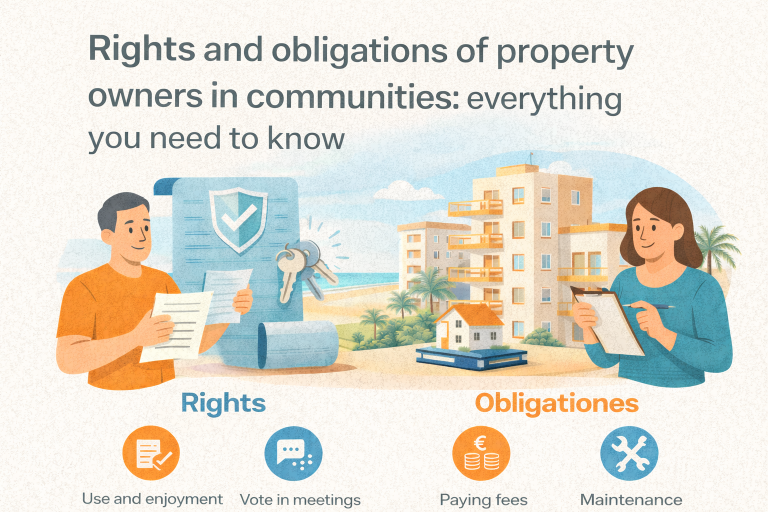
Quick overview: rights and obligations in a property owners community
| Owners’ rights | Owners’ obligations |
|---|---|
| Use common areas | Pay community fees and shared expenses |
| Attend and vote in community meetings | Maintain the property in good condition |
| Propose topics for meetings | Respect common areas and coexistence rules |
| Carry out renovations in their property | Allow necessary repairs |
| Request proper maintenance of the building | Notify ownership changes |
Main obligations of property owners in a community
Owning a property within a community involves certain legal and financial responsibilities aimed at ensuring the proper maintenance of the building and respectful coexistence among neighbors.
Paying community fees and shared expenses
One of the most important obligations is contributing to the general expenses of the building according to each property’s participation quota. These fees cover services such as cleaning, elevator maintenance, lighting, repairs, and other communal services.
Even if a specific service is not used, owners are still required to contribute to its cost unless the community statutes state otherwise.
Maintaining the property in good condition
Each owner must keep their property in proper condition to prevent damage to the building or to neighboring properties.
If a private installation causes damage to common areas or other apartments, the owner will be responsible for the repairs and any associated costs.
Respecting common areas and coexistence rules
Common areas such as staircases, gardens, garages, or swimming pools must be used appropriately and according to the community’s internal rules.
The Spanish Horizontal Property Law also prohibits activities that are disturbing, unhealthy, dangerous, or illegal within the building.
Allowing necessary repairs
In certain situations, the community may need access to a private property to carry out work related to common elements of the building, such as pipes, drains, or structural installations.
In these cases, the owner must allow access, although the community must repair any damage caused during the work.
Informing the community about ownership changes
When a property is sold, the former owner must notify the community administrator or secretary so that the records can be updated.
Owners should also provide a valid address for receiving official community communications if they do not live permanently in the property.
Rights of property owners in a community
In addition to their obligations, property owners also have several rights that guarantee their participation in community management and the proper use of shared facilities.
Use and enjoyment of common areas
All property owners have the right to use common facilities such as gardens, swimming pools, elevators, and recreational areas, as long as they respect the intended use and community rules.
Attending and voting in owners’ meetings
Owners’ meetings are the main decision-making body within a community. During these meetings, budgets, renovations, internal regulations, and other important matters are discussed and approved.
Property owners can attend, participate in discussions, and vote on decisions as long as they are up to date with their community payments.
Requesting topics to be included in the meeting agenda
Any owner can request that a specific issue be included on the agenda of a community meeting by notifying the president or administrator in advance.
Carrying out renovations inside the property
Owners may carry out renovations inside their property as long as the work does not affect the building’s structure, safety, or external configuration.
These works must also not infringe upon the rights of other neighbors and usually need to be communicated to the community beforehand.
Requesting proper maintenance of the building
Property owners have the right to demand that the building be kept in adequate conditions of safety, accessibility, and habitability.
If structural problems or necessary repairs arise, any owner may request that the community take the appropriate actions.
The role of the property manager
Managing a community of property owners can be complex, especially when conflicts or legal questions arise.
A professional property manager is responsible for handling accounting, organizing meetings, coordinating building maintenance, and ensuring that community decisions comply with the Spanish Horizontal Property Law.
They also act as mediators between neighbors and help resolve issues related to community regulations and shared responsibilities.
Conclusion
Understanding the rights and obligations of property owners in communities is essential to ensure proper coexistence and effective building management.
When owners fulfill their responsibilities, respect community rules, and participate in decision-making, the community operates more efficiently and conflicts between neighbors are significantly reduced.